


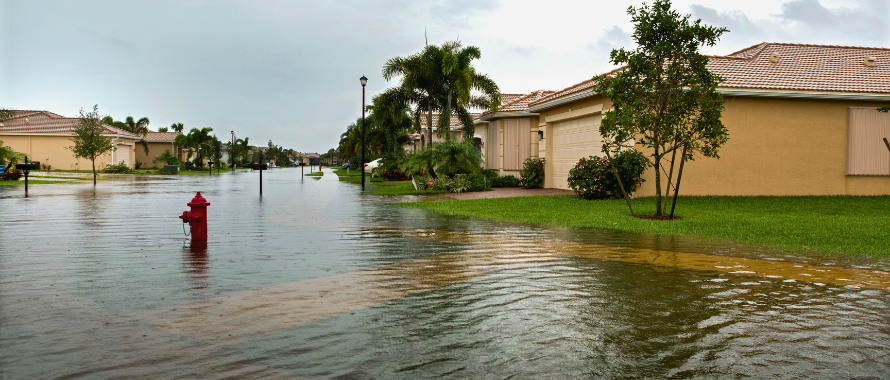
Flooding is the nation’s most frequent and expensive natural disaster, affecting property owners from coastal cities to inland towns alike. Even a few inches of water can cause catastrophic damage, disrupt operations, and leave homeowners and business owners facing massive repair expenses. To learn more about Flood Insurance and new products reshaping the marketplace, we spoke with Brad Turner, Vice President, National Product Manager, Flood, Burns & Wilcox, Morehead City, North Carolina.
We all know that floods can strike anywhere, often when individuals least expect it. Can you help explain the true scope of flood risk, both for homeowners and businesses across the country?
BT: What we have seen in the last 10 years or so is that many of the flood events are happening in areas where you would not expect it. Looking at FEMA flood maps, these “low-risk” flood zones are driving more than 40% of flood losses in the last 10 years. These are the same zones that are not required to purchase Flood Insurance. A statistic that really strikes me is that you are 30 times more likely to experience a flood loss during a 30-year mortgage than you are a fire loss. Given that context, it is really astounding that we do not see more uptake for Flood Insurance in the United States. A big part of what we do at Burns & Wilcox is really try to educate homeowners about the innate risk they face and the risks they will experience going forward.
Burns & Wilcox offers a full spectrum of flood protection products, from Primary and Excess Flood Insurance policies to Parametric Flood Insurance options. Can you walk us through what that range looks like, and how brokers can match clients with the right level of protection?
BT: We pride ourselves at Burns & Wilcox on a really consultative approach where we evaluate the situation, the budget, and the key factors for the client including what they are interested in covering. The Flood Insurance options that are available in our portfolio are very expansive. We do everything from offering National Flood Insurance Program (NFIP) options to expanded coverages and limits through private Primary and Excess Flood Insurance options. We are also heavily specialized in Parametric Flood Insurance, including our own binding authority within that space. By aligning data with cutting-edge technology, we can offer some very creative solutions for our clients when it comes to flood risk.
What innovations has Burns & Wilcox implemented to make Flood Insurance faster and easier to place?
BT: As technology has grown in the flood space, especially with private Flood Insurance, a lot of clients and agents like to see instantaneous quotes and manage their own policies. At Burns & Wilcox, we have our IssueQuick platform, which is newly designed to offer a comparative rating solution. Not only does it give instantaneous quoting, but it guides our clients through multiple options and how they differ. Our expanded portfolio offers a wider array of solutions for more complex risks, and if it does not fit within our IssueQuick platform, we have our award-winning flood practice standing behind it, ready to pivot and offer other solutions. Something else we have offered from a technology standpoint is the ability to analyze property for our clients, which allows us to proactively identify flood risks.
Why is the Excess and Surplus (E&S) market playing a critical role in today’s Flood Insurance landscape?
BT: The NFIP lapses that have occurred really prove the necessity of the E&S market. During those lapses, the private market has been able to shine and show what it can do from a coverage and options standpoint. Over the last 10 years, the E&S space has become very innovative to offer Flood Insurance solutions that did not exist before — including Parametric coverage, more competitive pricing advantages, and more expansive inclusions and limits. It is an exciting time to be in E&S and the private space for Flood Insurance. Anytime we have a lot of competition, it drives that innovation and the ability to offer better solutions for the consumer overall.
What are some of the unique flood risks high-value homeowners may face, and what Flood Insurance solutions should they know about?
BT: Most of the high-value space is very underinsured. The NFIP’s $250,000 limit for a dwelling creates a big coverage gap in this space, where many homes are worth $5 million or more. These homeowners often do have an NFIP policy, but they may not have an Excess Flood Insurance policy to cover those extended limits. The reality is that reconstruction costs have gone up 40% post-pandemic, high-value homes may have special types of contents such as fine art or collectibles, they may have additional buildings on their property, and their indirect loss expenses may be higher. The NFIP does not cover these scenarios very well. In the private Flood Insurance space, there are a lot of better solutions that broaden the definition of flood, broaden the coverage inclusions, and really help encapsulate a better coverage option for these high-value clients who face a greater flood risk than the average population.
Parametric Flood Insurance has been called one of the most innovative tools in the market. How does this coverage work?
BT: Parametric Flood Insurance is a very innovative aspect of the E&S space. With a typical Flood Insurance policy, you buy a limit, the language describes what is covered, and then after a claim, you have an adjuster come out and interpret that language. Parametric actually works in the reverse. You have a set limit, and that limit is only activated by a designated trigger. This trigger could be water depth at the property, or a percentage of a boundary around the property that is inundated with water, and that will correlate to a payout without anybody coming out to adjust the claim. Claim payouts can happen in less than a month, whereas the typical adjustment for a complex flood claim could be two to three months. It is very simplified. Parametric Insurance also allows you to cover some hard-to-place locations, such as Florida and along the coastlines, and it can cover things like docks and bridges that we normally could not.
What are some key tips for brokers that can help them speak confidently about flood risk and present these expanded solutions to clients?
BT: The biggest key takeaway for brokers — and this is going to sound very simple — is to talk about flood risk every time. Make it part of the solution every single time you are talking to a client. At the very least, they need information to be able to really calculate their risk. Too often, we are allowing lending institutions or an imaginary line in the sand to predicate the need for Flood Insurance. In a worst-case scenario, that leaves homeowners very exposed and they do not even know it. So, talk about it and lean into your wholesale partners that have access to the latest flood risk technology and data so that you can speak confidently with your clients. The news is active enough every year with flood events that most individuals understand that flood risk exists. It exists at a higher level than it did in the past, and it is only going to increase. Being consistent with this conversation is going to benefit consumers overall.
Flood Insurance
WHY YOUR CLIENTS MIGHT NEED IT: Flooding is the most common and costly natural disaster in the U.S., and it can strike anywhere — far beyond designated flood zones. Even one inch of water can cause tens of thousands of dollars in damage, leaving uninsured property owners with devastating losses.
PROTECTS AGAINST: Covers physical damage to buildings and contents caused by inland flooding, storm surge, heavy rainfall, and more. Excess Flood Insurance can extend coverage limits beyond standard policies to help fully protect high-value homes and commercial properties.
EXPERT OPINION: “Looking at FEMA flood maps, these ‘low-risk’ flood zones are actually driving more than 40% of flood losses in the last 10 years. These are the same zones that are not required to purchase Flood Insurance.” – Brad Turner, Burns & Wilcox