

Inside This Article:
- Two major warehouse fires that erupted in California within the span of a week caused significant physical damage and raised environmental concerns.
- Officials are investigating the causes of both fires as cleanup efforts move forward.
- Property damage, business interruption, and environmental impacts can be covered by insurance policies including Commercial Property Insurance and Site Pollution Liability Insurance.
- Accurate property valuations and disclosing hazardous materials can help businesses reduce the risk of coverage gaps.
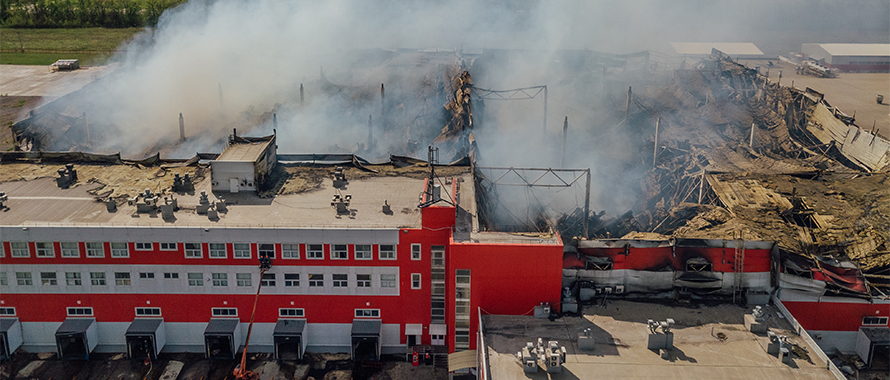
Two massive warehouse fires in California within the span of a week have highlighted how a single blaze can trigger far more than property damage for warehouse owners. Just days after a massive fire destroyed a medical supply warehouse in Tracy, another blaze broke out at a large cold-storage warehouse near downtown Los Angeles.
The Tracy fire, which began June 11, destroyed a roughly 1 million-square-foot Medline Industries distribution center. While investigators worked to determine the cause of the fire, recovery efforts shifted to environmental cleanup, according to CBS News Sacramento. A resident in Tracy has since filed a lawsuit against Medline over alleged health effects due to the smoke, claiming that the company allowed millions of pounds of “highly flammable and toxic materials” to be stored at the warehouse, KCRA 3 News reported July 3.
Just days later, on June 17, a fire at a 491,000-square-foot cold-storage warehouse in Los Angeles prompted officials to advise nearby residents to remain indoors while emergency crews monitored potential air quality concerns, according to the Associated Press.
“This kind of incident happens more often than we think,” said Kyle Rix, Senior Broker, Commercial Insurance, Burns & Wilcox, Seattle, Washington. “In the state of Washington, we have a lot of fruit business, and we have seen several environmental claims related to cold storage facilities as a result of fires or ammonia leaks. They are a lot more common than you might think and they can become very costly.”

Site Pollution policies can be one of the broadest insurance policies you have.
Commercial Property Insurance and Environmental Insurance policies can play an important role in helping businesses recover from warehouse fires and can respond to claims of property damage, operational disruptions, environmental contamination, and more.
“There are multiple layers of insurance that could respond in a claim like this,” said Lisa Campbell, Associate Manager, Halifax, Atlantic Division, Burns & Wilcox, Halifax, Nova Scotia. “Both of these incidents are quite significant. They can have a very big impact.”
Losses can include property damage, business income
In 2023, nonresidential building fires in the U.S. caused more than $3.1 billion in losses, according to the U.S. Fire Administration. Between 2014 and 2023, there was a 19% increase in nonresidential fires and a 10% increase in fire-related dollar losses, the administration reported. In 2024, fires overall caused an estimated $19 billion in property damage, according to the National Fire Protection Association.
A warehouse fire can affect more than the building itself. Depending on the circumstances, businesses may face damage to equipment and inventory, along with lost income if operations are forced to shut down. “Any warehouse or manufacturing and processing facility poses a higher risk inherently just due to the type of operations that they undertake,” Campbell said.

Any warehouse or manufacturing and processing facility poses a higher risk inherently just due to the type of operations that they undertake.
After a warehouse fire, a company’s Commercial Property Insurance can help cover damage to buildings, equipment, and inventory, while policy enhancements like Business Interruption Coverage can help replace lost income while operations are suspended following a covered property loss. In many cases, replacing specialized equipment, rebuilding facilities, and securing temporary operating space could take months, Campbell said.
“With a 1 million-square-foot facility, it can be difficult to relocate and to bring all of that product back,” she said. “A fire could be quite damaging to a company if they do not have the right coverage in place or the right financial safeguards to be able to get their business back up and running.”
A fire could be quite damaging to a company if they do not have the right coverage in place or the right financial safeguards to be able to get their business back up and running.
Environmental concerns can complicate recovery
Fires involving warehouses and manufacturing facilities can create serious environmental concerns. On July 5, a state of emergency was issued in Parkersburg, West Virginia, after a warehouse caught fire and reportedly released toxic chemicals into the environment, according to WDTV. On July 3, an industrial fire in Connecticut required environmental contractors to assist with cleanup after specialized firefighting tactics were used to contain burning aluminum, the New Haven Register reported.
Site Pollution Liability Insurance, also known as Pollution Legal Liability Insurance, is a type of Environmental Insurance designed to help address pollution-related losses that are most likely excluded under other insurance policies. This can include coverage for environmental cleanup, third-party bodily injury or property damage claims, legal defense and settlements, loss of income, and other expenses related to covered pollution incidents.
“Site Pollution policies can be one of the broadest insurance policies you have,” Rix said. “There are two parts — the third-party component, which is if a third party brings a claim against you as a result of a pollution incident claiming bodily injury, property damage, or cleanup cost of their property; and the first-party component, which is your cost related to a pollution incident on your site and now you have to clean up your own site as well as additional expenses related to the incident.”
Recovering from an incident that has an environmental impact on the surrounding community is often extremely time-consuming and costly, Campbell said. “Environmental cleanup can go on for many years due to testing and retesting, making sure the cleanup is done correctly, and the widespread exposure something like this could have on a community as a whole,” she said.
While Commercial General Liability (CGL) Insurance may include limited coverage for third-party injuries and property damage related to pollution from a fire, coverage varies and specialized Environmental Insurance is typically needed. Rix said he worked with a group of warehouses that declined Site Pollution Liability Insurance — quoted at $8,000 for $2 million in coverage — and later had an ammonia leak at one of their facilities that forced the evacuation of 100 nearby homes and resulted in more than $1 million in costs. When the company later sought out a pollution policy, the premium had increased to nearly $100,000 for the same coverage.
“The key is to buy it before you have something happen,” Rix said.
The key is to buy [Environmental Insurance] before you have something happen.
Reviewing coverage before disaster strikes
Warehouse owners should regularly evaluate whether their insurance policies reflect current operations and risks. Changes such as expanding facilities, storing new products or hazardous materials, or purchasing additional equipment can affect coverage needs, Campbell explained.
“Make sure that you know the limits are adequate for your actual risk exposure and that the insurance company knows exactly what you are doing in the building,” she said. “Insurance is one of those things where individuals know that they need it but they might not fully understand it. Always review your policy at renewal, talk with an insurance professional, and make sure all of your information is up to date.”
Companies looking to purchase new manufacturing facilities or warehouses should do their due diligence and obtain a Phase I Environmental Site Assessment, which can identify how a property was used in the past and any potential need for remediation, Rix said. When purchasing insurance coverage, business owners should also be prepared to share information on their fire suppression systems, storage practices for hazardous materials, disposal practices, and employee safety training.
“Keep up to date with the standards of today,” he said. “The way you did it 35 years ago may not be OK anymore.”