


Inside This Article:
- Hail is now a leading driver of severe convective storm losses, according to Cotality’s latest storm risk report.
- Texas had the most hail losses of any state in 2025, with more than 235,000 homes experiencing hail damage.
- Insurers are increasingly implementing Wind and Hail Deductibles and Roof Settlement Schedules on Homeowners Insurance policies.
- Property owners should closely review policy terms to help avoid unexpected coverage gaps.
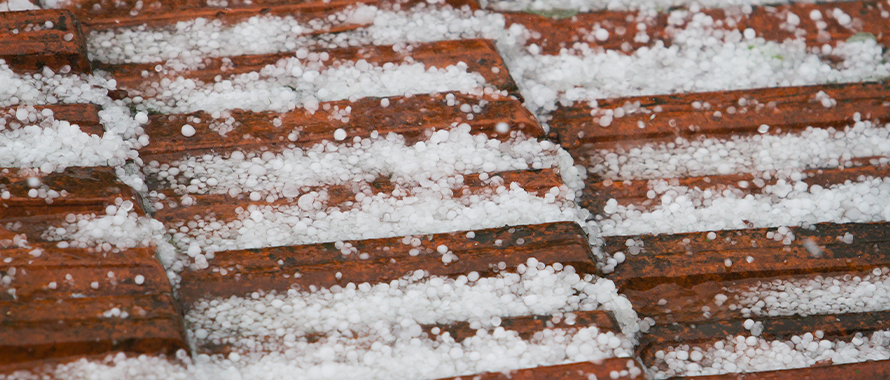
Hail risk is intensifying as severe convective storms become more frequent and more damaging. According to Cotality’s 2026 Severe Convective Storm Risk Report, more than 43.5 million U.S. homes now fall within areas facing moderate or greater hail risk, representing an estimated $17.84 trillion in reconstruction costs. Texas tops the report’s list of hardest-hit states in 2025, with more than 235,000 homes impacted.
Recent industry reports identify hail as a primary driver of losses from severe convective storms, which also include tornadoes and straight-line winds. Across multiple modeled scenarios, hail accounts for a significant share of insured damage and, in some cases, could reach levels comparable to a Category 4 hurricane.
“There is definitely more hail. The weather seems to get worse and more intense each year,” said Lisa Stout, Director, Personal Insurance, Burns & Wilcox, Dallas/Ft. Worth, Texas. “What we used to see concentrated in areas like Dallas, Tarrant, Denton, and Collin counties [in Texas] is now spreading farther, into places like Austin and San Antonio.”
Just days ago, Stout said, a storm brought damaging hail to multiple Texas communities. Property owners typically rely on Homeowners Insurance for residential properties and Commercial Property Insurance for business properties to help cover hail-related damage, though the scope of that protection continues to evolve along with the increasing risk.
“Awareness of hail risk from a general population standpoint has slowly begun to increase,” said Ryan Connolly, Regional Practice Group Leader, Personal Insurance, Burns & Wilcox, based in Nashville, Tennessee. “As an industry, we have for several years now begun to recognize the challenges associated with severe convective storms.”
Hail losses occurring outside of traditional storm regions
Severe convective storms have become one of the largest sources of insured losses in the U.S., with these events driving billions of dollars in damages each year. In 2025, 21 of the 23 billion-dollar disasters were severe convective storms, according to data from Climate Central. These storms caused approximately $51 billion in U.S. insured losses, the Insurance Information Institute reported in April.
“The numbers are certainly staggering when you think about it,” Connolly said. “It speaks to the nature and extent of damage that can be caused by these events, whether it is hail or tornadoes or straight-line wind.”

The numbers are certainly staggering when you think about it. It speaks to the nature and extent of damage that can be caused by these events, whether it is hail or tornadoes or straight-line wind.
The combination of more frequent storms and higher property values and reconstruction costs has amplified total losses, he said.
“You cannot deny the frequency of these events is increasing year over year. There is also an increase in buildings in these areas and the cost of repairs has grown,” Connolly said. “When the damage is done and the repair work has to be completed, the cascading effect of surge pricing due to limited resources and a lack of contractors available to do the work adds to the overall cost.”
Hail risk is no longer confined to historically vulnerable regions. In Cotality’s report, the 43.5 million properties found to be at moderate or greater risk for hail represented 42% of all properties analyzed. As storm activity expands into areas less accustomed to frequent hail events, many homeowners may not fully grasp the risk.
“Depending on the size of the hail, it can actually break through roofing material or break out windows. It can be extremely damaging,” Stout said. “Unfortunately, convective storms and hail damage are so unpredictable. You really do not know where or when it is going to hit or how severe the storms are going to be.”

Depending on the size of the hail, it can actually break through roofing material or break out windows. It can be extremely damaging.
Carriers adapt coverage to reflect growing risk
As hail risk intensifies, Homeowners Insurance carriers are responding by adjusting policy structures, particularly in regions with a history of frequent storm activity. These changes often include percentage-based Wind and Hail Deductibles — calculated as a percentage of a home’s insured value rather than a flat dollar amount — as well as Roof Settlement Schedules, which determine claim payouts based on the age and condition of the roof.
“The majority of the policies in Texas have gone to a 2% Wind and Hail Deductible,” Stout said, adding that a Wind Deductible Buy-Back policy may be available in some cases to bring deductibles down to 1% or a set dollar amount.
Homeowners should be mindful of these potential changes, Connolly said. “I do not necessarily think that they are negatives — they are risk mitigation elements — but it is something that the insured needs to be aware of and understand,” he said.
They should also review whether their policy includes Replacement Cost Value (RCV) or Actual Cash Value (ACV), as depreciation can significantly reduce what a policy pays on an older roof. “You would expect a newer roof to receive the broadest coverage possible, whereas a roof that is 10 to 15 years old and has been through many storm cycles may be looking at Actual Cash Value versus Replacement Cost,” he said.
If property owners do not understand how their policy would respond in the event of roof damage caused by wind or hail, they could face unexpected out-of-pocket expenses — especially given rising material and labor costs, Stout said.
“The exact same roof that you could get done for $5,000 to $6,000 in 2015 could easily cost $10,000 to $12,000 today,” she said. “Some policies also have what they call a Cosmetic Damage Exclusion; for example, if a metal roof is covered in hail dents [but remains intact], insurance may not pay anything.”
Understanding coverage key to recovery
As hail losses escalate, understanding policy terms is increasingly important for homeowners navigating hail risk. This becomes especially important after a loss, when policyholders must interpret coverage terms while managing repairs.
“The key takeaway is that the homeowner, their retail agent, and the insurance carrier work collectively to make sure the insured feels adequately covered,” Connolly said. “Protection of your largest asset is of significant importance.”
The key takeaway is that the homeowner, their retail agent, and the insurance carrier work collectively to make sure the insured feels adequately covered. Protection of your largest asset is of significant importance.
Regular policy reviews can help prevent unexpected coverage gaps as conditions change over time, Stout added. “They definitely should be reviewing their policies each year as they come up for renewal so they are aware of deductibles and endorsements that may be added at renewal,” she said. “It is more important to shop for coverage rather than price. You do not want to get the surprise that you do not have the coverage when you need it.”
It is more important to shop for coverage rather than price. You do not want to get the surprise that you do not have the coverage when you need it.