

Inside This Article:
- Heavy snowfall, wind, and ice from a major Northeast blizzard in February is expected to cost up to $38 billion, including costly residential damage claims.
- Ice dams, roof collapse, and slippery walkways are among the risks homeowners face after severe winter storms.
- Damage related to blizzards is typically covered under Residential Property Insurance, though policies may respond differently depending on the type of loss.
- Icy conditions can increase the risk of slip-and-fall accidents outside of residential properties, potentially creating liability exposure for homeowners.
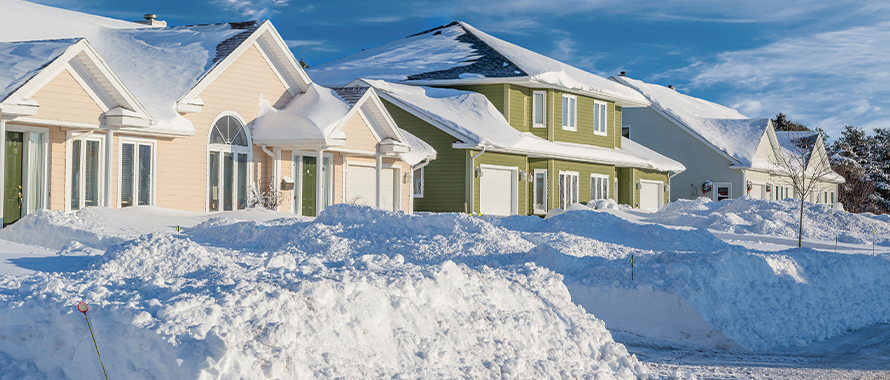
A historic blizzard that buried parts of the Northeast under several feet of snow is expected to carry a significant financial toll. AccuWeather estimates the Feb. 22 to Feb. 24 storm caused between $34 billion and $38 billion in total economic loss, making it one of the costliest winter weather events in recent years.
The storm brought heavy snowfall, powerful winds, and widespread power outages across multiple states, with at least 18 Northeast cities seeing official blizzard conditions and some areas accumulating more than 2 feet of snow within a short period. High winds during the storm reportedly reached hurricane strength in places like Cape Cod and Nantucket, while contractors in New York have seen a surge in demand for roof work as homeowners battle ice dams.
“This is the most snow we have seen at one time in certain areas in almost 50 years, so we are talking about a generational event. It is hard to prepare for that,” said Andrew Boyle, Senior Underwriter, Personal Insurance, Burns & Wilcox, Boston, Massachusetts. “The combination of the wind and the type of snow we received makes it a lot more likely to generate costly claims.”

The combination of the wind and the type of snow we received makes it a lot more likely to generate costly claims.
From roof stress to water intrusion and hazardous walkways, winter storms can present a range of risks for homeowners. Property damage and liability claims related to winter storms can generally be covered under Residential Property Insurance, also known as Homeowners Insurance, though severe slip-and-fall claims could necessitate additional liability coverage through a Personal Umbrella Insurance policy.
“This winter has definitely been more impactful than prior years. We are used to snow here, but not necessarily on the level of more than 20 inches,” said Drew Bonocore, Senior Underwriter, Personal Insurance, Burns & Wilcox, New York, New York. “The losses could definitely be significant, especially with all the types of Homeowners Insurance claims that could come into play from storms like this. There is often a hyper-focus on hurricanes, but these winter storms can also bring high winds, as we saw with this storm.”

There is often a hyper-focus on hurricanes, but these winter storms can also bring high winds, as we saw with this storm.
Risk of ice dams, roof stress after heavy snowfall
Large snowstorms can pose several structural challenges for homes, especially roofs, including ice dams — ridges of frozen water along rooflines that can trap melting snow and lead to water seepage into ceilings and walls. After a winter storm in Connecticut earlier this year, roofing companies received an influx of calls from homeowners regarding ice dams and interior water damage, WFSB-TV reported, and one homeowner told the news outlet that she needed to replace her roof last year due to damage from ice dams.
“One of the biggest issues we see is ice dams,” Boyle said. “They essentially create a barrier that stops additional melt from going into the gutters. That causes water to seep into the home, which is obviously not where you want it to go.”
When ice dams build up amid continuously cold temperatures, the risk of water damage increases, Bonocore said. This is particularly concerning for secondary or seasonal homes, where problems may not be noticed until the damage is more severe. “If you have a secondary property that is unoccupied during the storm, that location should be checked on by the insured or by a suitable individual or caretaker,” he said.
Frozen pipes, damage from fallen trees, and broken windows are among other winter storm perils for homeowners. In severe cases, heavy snow accumulation can lead to roof collapse, Boyle said.
“When you get a lot of snow in a very short period of time, a roof can be weighed down by that sudden influx of heavy, wet snow,” he said. “It can be rife for collapse.”
How insurance may respond to winter storm exposures
Severe winter weather can lead to costly insurance claims for homeowners. A winter storm that hit parts of the Eastern and Southern U.S. earlier this year resulted in about $6.7 billion in privately insured losses, according to catastrophe modeling firm Karen Clark and Company, Reuters reported Feb. 3.
Many types of winter storm losses can be covered under a standard Homeowners Insurance policy, including damage from wind, heavy snow, frozen pipes, and other “sudden and accidental” losses, Boyle said. “Homeowners insurance typically has all-inclusive coverage unless something is specifically excluded,” he said. “I encourage homeowners to go through their policies, talk with their agent, and see what type of exclusions are included.”
While smaller losses such as food spoilage are common due to storm-related power outages, Homeowners Insurance is generally “intended for those big losses that you cannot shoulder yourself,” he said.
Some perils may require separate coverage, Bonocore pointed out, including coverage for flood and mold. “Flood is generally excluded on a Homeowners Insurance policy, therefore a separate Flood Insurance policy would be needed for that peril,” he said. “Mold claims can also occur from the melting snow and ice, and that is a separate coverage you can purchase via endorsement.”
In addition to carrying insurance, homeowners can help protect against severe losses by mitigating prior to storm damage rather than once it is discovered. Keeping up with regular home maintenance, having storm supplies readily available, and installing automatic water shutoff devices that monitor plumbing are all examples of mitigation, Bonocore said. “If the automatic water shutoff device detects a leak, it will cut off the water supply to the home,” he said.
Liability risks on icy property
Snow and ice removal are also critical, and homeowners should know that they can be held liable for slip-and-fall injuries that occur on their property due to dangerous conditions. With regard to liability, in addition to snow removal, it is recommended to apply salt/snow melt on all walkways and entryways to help prevent slip, trip, and fall claims that can occur post-storm.
“When you have a lot of slippery sidewalks and walkways, your potential for slip-and-fall claims is larger,” Boyle explained. “It is often not clear to a homeowner where their responsibility for clearing snow and ice ends and where the public sidewalk picks up. It can be different from city to city, town to town, but you owe a duty of care to invited guests — and uninvited guests, like a neighbor coming to check on you — in terms of allowing safe access to the home.”
Liability limits on a standard Homeowners Insurance policy may not be enough for a severe slip-and-fall claim, so a separate Personal Umbrella Insurance policy is often recommended, Boyle said. “Liability claims can be enormous,” he said. “Homeowners often assume that if they get sued, they can only sue you for what you have — but in a lot of states, they can be sued for future wages. It can ruin you financially. It is not that expensive to buy additional liability protection relative to property coverage, but the peace of mind you get from having it is huge.”
Liability claims can be enormous. … It is not that expensive to buy additional liability protection relative to property coverage, but the peace of mind you get from having it is huge.
These policies often range from $1 million to $5 million in additional liability coverage, Bonocore said. “We definitely encourage homeowners to explore that option,” he said. “It is important to work with your agent and understand how your policy works, what it covers and does not cover, and then the consumer can make an educated decision.”
It is important to work with your agent and understand how your policy works, what it covers and does not cover, and then the consumer can make an educated decision.