

Inside This Article:
- A recent crane collapse at a Fort Lauderdale YMCA construction site sent equipment partially into the road just feet from a passing driver.
- Improperly secured loads, inadequate crane stabilization, loads near or above capacity, and wind are among the most common conditions that contribute to crane incidents.
- Damage to the project or surrounding property can lead to costly third-party liability claims, which may be covered by Commercial General Liability (CGL) Insurance and Excess Liability Insurance.
- Construction companies may also need specialized insurance coverage for mobile equipment, employee injuries, and more.
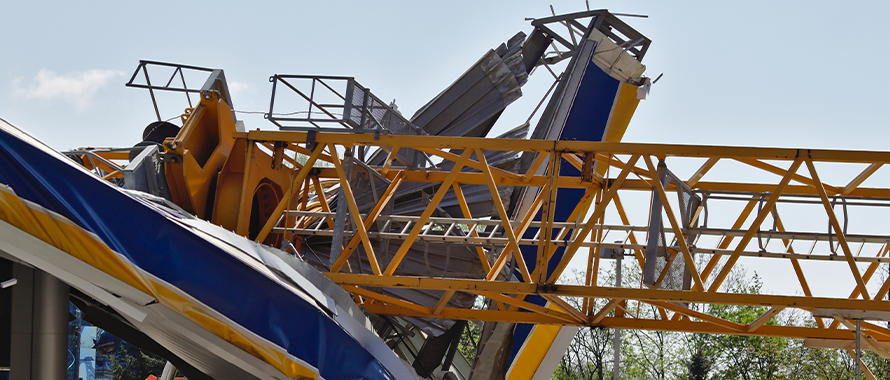
A passing motorist narrowly avoided disaster when a crane collapsed just feet from his vehicle on a roadway near a YMCA facility construction site in Fort Lauderdale, Florida. The crane knocked down a wall of the building under construction and extended into the first lane of Federal Highway, WSVN-TV reported.
The collapse, which was captured on dashcam footage, led to road closures and delays as crews determined how to remove the crane without worsening the damage. According to news outlets, no injuries were reported and a local inspector and the Occupational Safety and Health Administration were investigating the incident.
“It definitely does not shock me to see something like that happen,” said Justin Peterson, Underwriter, Commercial Insurance, Burns & Wilcox, Orlando, Florida. “It is high-hazard work, and these things can happen. It is fortunate no one was hurt.”
For construction companies, crane incidents can lead to serious losses including damage to the project, the equipment, and property outside of the construction site, as well as potential employee or third-party injuries. Construction Insurance can help address these risks through Commercial General Liability (CGL) Insurance, Excess Liability Insurance, and other policies.
“Safety protocols have to be very closely followed because it is hard to control such large pieces of equipment being moved,” said Jeff Sygit, Underwriter, Commercial Insurance, Burns & Wilcox, Denver, Colorado. “If something is not within guidelines [and an incident occurs], it is usually not a small claim; it is usually a very significant event.”
Safety protocols have to be very closely followed because it is hard to control such large pieces of equipment being moved. If something is not within guidelines [and an incident occurs], it is usually not a small claim; it is usually a very significant event.
Improper harnessing, wind among common crane collapse causes
Just weeks after the Fort Lauderdale incident, a crane that was still being assembled at a Miami high-rise construction project collapsed and fell into a rooftop pool, WKRC/CBS Newspath reported. No injuries were reported, but the pool was closed as OSHA investigated and repairs were made.
Crane-related losses usually trace back to a handful of operational failures, Sygit said, including improperly harnessed loads, incorrect stabilization, weight near or above capacity, and wind.
“Typically, crane losses fall into one of those categories,” he said, noting that even a slight shift in conditions can have serious consequences. In a prior loss, for example, wind speeds were only 2 to 3 miles per hour above the acceptable limit, but it made the item being lifted “act like a sail” and led to major damage. “If certain conditions are not right, the day has to be canceled or a waiting period must be observed.”
Severe weather can create another layer of risk, particularly for cranes used on high-rise projects, according to Peterson. “During hurricane season, if a crane is left up, the hurricane winds can blow it over,” he said.
Safety planning plays a role in how insurers evaluate crane exposures, as the higher level of hazard makes these operations more challenging to insure. “It is one of the tougher classes,” Peterson said. “There will be times where carriers will ask for a safety plan.”
Property damage and liability risks
A crane collapse at a Florida hospital construction site last year underscores how serious these incidents can become. In June 2025, two individuals died after a crane fell at the site of the Cape Canaveral Hospital in Merritt Island, the Associated Press reported. Rain and strong winds had reportedly moved through the area at the time of the incident.
When cranes strike a project or nearby buildings or vehicles, the resulting losses can lead to significant third-party liability claims, Peterson said. “When a crane lands on a building or a bunch of cars, those are the losses that I have seen most,” he said. “There is definitely the potential for a lot of different third-party claims.”
When a crane lands on a building or a bunch of cars, those are the losses that I have seen most. There is definitely the potential for a lot of different third-party claims.
For general contractors, CGL Insurance is essential for responding to third-party bodily injury and property damage claims, including coverage for legal defense, settlements, and other costs. Excess Liability Insurance can provide an additional layer of liability coverage.
“An accident with a crane could potentially activate the CGL Insurance coverage if it leads to a loss for the property the insured is working on or potentially adjacent properties,” Sygit explained. “There are quite a few factors that go into a crane-related claim situation and the coverage as it comes together.”
An accident with a crane could potentially activate the CGL Insurance coverage if it leads to a loss for the property the insured is working on or potentially adjacent properties.
For companies that own cranes and rent them to others, Crane and Riggers Liability Insurance may be part of a specialized Construction Insurance program, Peterson said. “The exposure comes with them renting the crane to someone or letting a third party drive it themselves,” he said.
Workers’ Compensation Insurance can respond to employee injuries — an important consideration for companies whose employees may be exposed to job-site hazards — while coverage for the crane itself and damage to the project may require separate policies, including Inland Marine Insurance and Builders Risk Insurance, Sygit said. Environmental Insurance may also be needed.
Matching insurance coverage to the operation
Cranes can be used for smaller residential jobs, such as moving hot tubs onto decks or porches, as well as large urban projects, Sygit said. Given the wide range of potential operations, insurance needs often vary based on equipment and project scope. On larger construction projects, crane exposures may be addressed through a developer’s Wrap Policy or a project-specific insurance package, he said. “Typically, there are fewer markets that will rate for cranes, and the ones that do tend to specialize in that,” Sygit said.
For contractors, providing a clear description of the work being performed can help ensure their insurance policies address the risks they face. “You definitely want to work with an expert in the industry, not someone who just dabbles in it,” Peterson said. “They can make sure that the forms and rates are appropriate based on the exposures.”
You definitely want to work with an expert in the industry, not someone who just dabbles in it.
Many contractors may also consider Professional Liability Insurance when their work involves interpreting blueprints or other professional services, according to Sygit, who said he has seen “a slight increase in requests” from contractors for Professional Liability policies.
“For smaller general contractors, it is very important that they adhere to the operations that are covered in their policies,” he said. “Working with a knowledgeable agent who understands the construction process is very important.”