
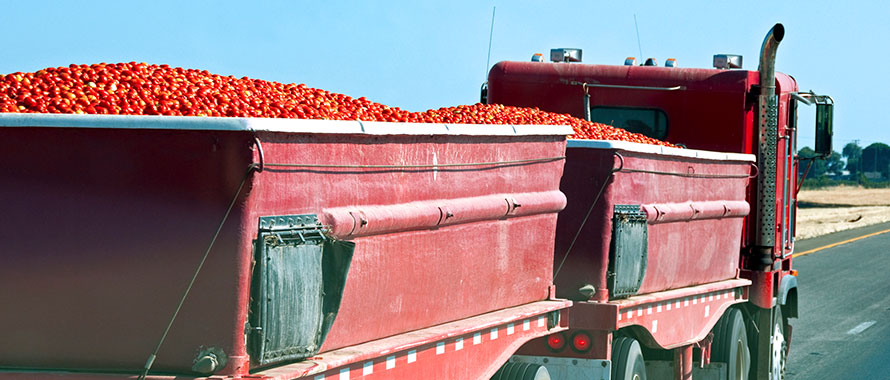
Two separate trucking accidents caused major spills of tomatoes and Alfredo sauce onto highways on different sides of the U.S. within hours of each other in late August, Today reported. The first incident took place Aug. 29 in Vacaville, California, when a big-rig truck went through the center divider and crashed, injuring three individuals and spilling more than 150,000 tomatoes across multiple lanes, which shut down one lane of traffic for at least six hours. The next day, one woman was injured and traffic was delayed after an 18-wheeler hauling hundreds to thousands of jars of Alfredo sauce crashed in Memphis, Tennessee, spilling sauce across all lanes and requiring hours of cleanup, according to reports.
Featured Solutions
“It appears that social media is introducing humor into the situation by making these two losses the subject of memes,” said Fernando Batista, Associate Manager, Transportation, Burns & Wilcox, Toronto, Ontario. “We have to remember three individuals were seriously injured. Someone could have lost their life.”
These high-profile incidents are also “a negative reflection on the industry itself,” Batista said, and come as transportation companies face pressing challenges, from the threat of nuclear verdicts to driver shortages and employee retention concerns. Major accidents also increase the cost of the insurance policies that trucking companies must carry in order to operate, including Truckers Auto Liability Insurance, Transportation Pollution Liability Insurance, Motor Truck Cargo Insurance, Auto Physical Damage Insurance, and Excess Liability Insurance.
“As loss severity increases, there is likely some mistrust in how these operations are managed and then, of course, insurance carriers are responding with increased rates,” said William Mills, Director, Transportation, Burns & Wilcox, Salt Lake City, Utah. “This increases the cost of commodities as the costs per load increase. It is just a ripple effect.”
Environmental damage can ‘dramatically’ increase accident costs
After a trucking spill, potential expenses can include cleanup costs, third-party property damage and injuries, natural resources damage, regulatory fines and penalties, vehicle repairs, and more. Clearing tomatoes or Alfredo sauce from a highway may not be as costly as more hazardous materials, Batista said. In August, a trucking company in Ukiah, California, was ordered to pay $90,000 in enforcement costs and penalties after a 2019 oil tanker spill dispersed up to 4,500 gallons of oil onto the road and nearby land connecting to a creek, the Press Democrat reported. In May, a transport truck was involved in an accident in Kingson, Ontario, spilling the load of fertilizer it was hauling and temporarily shutting down a major highway exit, Global News reported.

Trucking companies should make sure they are carrying adequate liability limits given the commodities they are hauling and having enough liability coverage to ensure they are prepared for a larger accident.
“When a spill involves something more hazardous, there would be more of a cleanup exposure, liability exposure, and pollution exposure. That could mean evacuating towns and pollutants getting into the water table — it would be a completely different set of costs,” Batista said. “Trucking companies should make sure they are carrying adequate liability limits given the commodities they are hauling and having enough liability coverage to ensure they are prepared for a larger accident.”
Even materials that are not considered hazardous, such as Alfredo sauce, can cause environmental damage in a spill incident, Mills pointed out. “With dairy being the main ingredient in Alfredo sauce, it can be a pretty intensive environmental cleanup operation depending on where the spillage occurred,” he said. “If there was any drainage into the water systems, the cleanup costs could escalate dramatically.”
While a transportation company’s Trucker’s Auto Liability Insurance can help with expenses such as cleanup, third-party bodily injury and property damage, and more, companies would generally need a separate Transportation Pollution Liability Insurance policy to cover spill-related environmental damage costs, Mills said. Physical damage to the truck is typically covered by the trucking company’s Auto Physical Damage Insurance, while loss of cargo can be covered by Motor Truck Cargo Insurance. Excess Liability Insurance is often recommended, as well.

With dairy being the main ingredient in Alfredo sauce, it can be a pretty intensive environmental cleanup operation depending on where the spillage occurred.
“The environmental cleanup costs for dairy, crude oil, gasoline, and in very intense cases, chemicals such as ammonia, could easily reach limits of up to $1 million, depending on where the accident happened, what the infrastructure looks like, and whether there is water drainage and seepage into the residential water supply,” Mills explained.
Nuclear verdicts continue to threaten transportation industry
Research from the American Transportation Research Institute released in 2020 found that large verdicts against trucking fleets were significantly increasing in number and size, including a 51.7% increase in the size of verdict awards between 2010 to 2018. During this time period, the average verdict size for a trucking crash lawsuit above $1 million increased almost 1,000%, CNBC reported. In 2021, a $1 billion verdict against a trucking company over a fatal 2017 crash was considered a possible new record for the largest nuclear verdict in the industry, FreightWaves reported.
The frequency of nuclear verdicts is certainly up. Losses exceeding the primary limits of $1 million are much more frequent now than they were even five years ago.
The definition of a “nuclear verdict” has changed over the years, Mills said, but is commonly considered to be one reaching in excess of $10 million or more. “The frequency of nuclear verdicts is certainly up,” he said. In addition, “losses exceeding the primary limits of $1 million are much more frequent now than they were even five years ago.”
These large losses “really have a far-reaching impact on many levels,” Batista noted. “If the trucking company involved was negligent, they expose themselves to a large liability claim and the risk of a nuclear verdict,” he said. “Nuclear verdicts are making it more difficult to secure higher liability limits. Trucking companies could be operating with lower than their desired Third Party Liability limits as these Nuclear Verdicts are keeping insurance carriers from making higher limits available.”
As insurance premiums increase in response, smaller trucking operations may be pushed out of the industry, Mills said. “Premiums are getting to a point where it is difficult to afford to operate as a non-fleet operator,” he said.
Focus on safety, training amid driver shortage
In 2021, the American Trucking Association estimated that the shortage of truck drivers reached an all-time high of 80,000 and could exceed 160,000 drivers by the year 2030. Contributing factors may include pay, e-commerce competition, retirements, and recruitment issues, CNBC reported in July. In Texas, some fleets have sought out foreign drivers to help fill positions, FreightWaves reported this month.
“We are seeing more companies in border states utilizing international drivers due to the driver shortage, or recruiting drivers from other states,” Mills said. “Some of the possible issues are when you have drivers who do not necessarily have the experience needed, or who do not have experience hauling specific loads, such as loads that have the potential to shift,” he said, pointing to the recent tomato spill.
Companies may be taking more risks in their hiring and employment practices due to the shortage, Batista said. “The driver shortage is definitely a contributing factor to preventable accidents. The less experience the driver has, the more likely they are to get into this type of accident. If companies take shortcuts in their hiring process just to fill positions, that puts everybody at risk.”
In Canada, expanding the category of skilled workers to include truck drivers would help hiring efforts immensely, Batista added. “Creating incentives to attract and retain new drivers could expand the hiring pool.”
A safety culture starts at the top and is ingrained into the DNA of the company, and that is the best way they can protect themselves.
Despite the staffing difficulties, trucking companies must continue to prioritize safety. Insurance carriers are increasingly requiring companies to utilize telematics and cameras, Mills said. This added technology can also assist in driver training efforts. “The telematics gives you an opportunity to counsel the driver. If they get caught for hard braking, speeding, or insufficient attention or looking down, they can use these samples as a training tool to counsel drivers,” he said. “These negative driver tendencies, if shown to be frequent within the data and without documented training, can potentially be used in litigation involving a claim.”
Incentivizing drivers to maintain a quality driving record, implementing pre-operational inspections, and having policies about cellphone use are among other recommended practices. “If your drivers are doing well, your premiums are most likely staying flat,” Mills added.
Transportation company owners should take the recent accidents involving tomatoes and Alfredo sauce as a reminder to keep safety at the forefront, Batista said. “It is so unlikely to have two similar losses like that happening, hours apart, in different parts of the country. It makes you wonder what trends are happening in North America that are contributing to these types of losses,” he said. “If they are preventable losses, what can we do as an industry to bring safety forward? A safety culture starts at the top and is ingrained into the DNA of the company, and that is the best way they can protect themselves.”