

Key Takeaways
- Property Insurance offers more competitive pricing and broader capacity, but brokers and agents should consider underwriting expertise, carrier appetite and policy terms & conditions, not just premium.
- Casualty Insurance faces pricing pressure across most lines of business stemming from rising litigation costs, social inflation, and nuclear verdicts, particularly in Auto and Excess Liability.
- Professional Liability is competitive across many classes, with increased capacity creating pricing opportunities. However, rising claims costs and varying market conditions reinforce the importance of comprehensive coverage and sound risk management.
- Artificial intelligence (AI) is creating emerging insurance exposures, prompting insurers to clarify policy language, consider endorsements, and assess how existing coverage responds to AI-related claims.
- International insurers are expanding their U.S. presence, bringing additional capacity and competition to the E&S marketplace.
INTRODUCTION
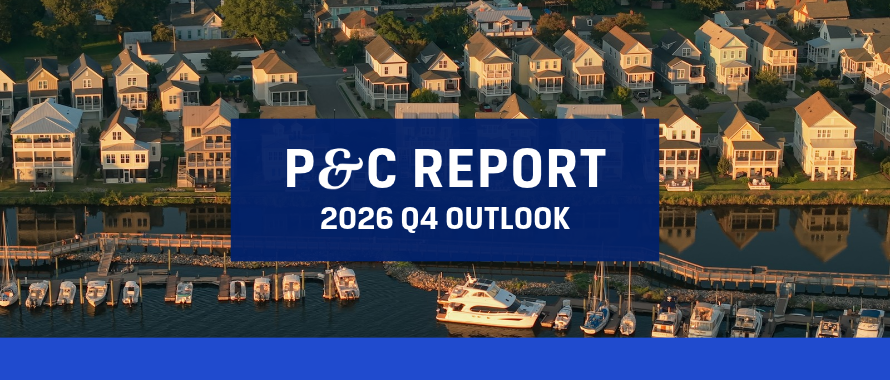
Increased capacity, heightened competition, and emerging risks are creating new opportunities and challenges across the Property & Casualty (P&C) Insurance marketplace as 2026 draws to a close.
In Property Insurance, these conditions support more favorable pricing and coverage options. Liability presents a different picture, as litigation trends and rising claims severity put pressure on rates.
Despite greater competition, insurers continue to emphasize disciplined underwriting and profitable growth. Market conditions vary considerably by coverage, geography, and individual risk, reinforcing the importance of specialized expertise, comprehensive submissions, and strong relationships as brokers and agents prepare for 2027.
International Expansion into the U.S. Market
International insurers are expanding their presence in the U.S. marketplace, bringing additional capacity and competition. Japanese groups such as Tokio Marine and Sompo, to name a few, have expanded through overseas acquisitions, while Korean insurers are pursuing opportunities beyond their domestic markets.
The motivations of these global carriers extend beyond current U.S. pricing. Mature domestic markets, aging populations, and limited growth prospects make overseas expansion attractive. The U.S. offers a large market and opportunities to diversify earnings, especially in the non-admitted space.
In an analysis published by Insurance Journal, Fitch Ratings reported that 86% of approximately $35 billion in major acquisitions by Fitch-rated Japanese insurers over the preceding decade involved U.S. investments. The analysis also noted that North America accounts for about 40% of global non-life insurance premiums.
Additional market participation can increase competition, although the effect on pricing depends on the risks and lines insurers choose to write.
RATES
Property Insurance pricing has become more competitive as insurers pursue business and capacity expands. Favorable July 1 reinsurance renewals helped support this trend. Most accounts qualify for lower rates and better terms, although results depend on location, loss history, occupancy, construction, and property valuations.
This does not mean Property Insurance rates will keep falling indefinitely. Discussions at the October Council of Insurance Agents & Brokers (CIAB) annual Insurance Leadership Forum reflected concerns about the current level of rates approaching or at their technical floors.
Liability presents a different picture. Commercial Auto remains particularly challenging, with many insureds facing double-digit increases. Other Casualty lines continue to face pricing pressure as insurers assess litigation trends and rising claims costs. Rates that do not keep pace with loss costs quickly erode underwriting profits.
Social inflation adds to these challenges. Larger jury awards, litigation practices, and third-party litigation funding can push claims costs beyond ordinary economic inflation. Recent Swiss Re Institute research estimates social inflation increased U.S. liability claims by 57% over the preceding decade.
CAPACITY
Although capacity has improved in several segments, market conditions vary considerably by coverage and risk. Insurers continue to prioritize underwriting discipline, profitability, and effective risk management as they prepare for 2027.
Increased Property Insurance capacity gives brokers and agents additional placement options. Admitted carriers are broadening their appetites in select areas, while international insurers pursue U.S. business. This creates opportunities to explore higher limits, fewer restrictions, and coverage for risks that previously attracted limited interest. However, these opportunities are account-specific, and catastrophe losses and changing regional conditions could affect pricing and availability.
The Excess & Surplus (E&S) market continues to play an important role for specialty and difficult-to-place risks, even as premium growth slows. AM Best reported total U.S. surplus lines premiums rose 10.4% in 2025 to $143.2 billion, while premium growth among domestic surplus lines insurers slowed to 8.9%.
AM Best also expects demand for customized coverage to limit a broad shift back to admitted carriers. Price matters, but so does the ability to address complex and emerging exposures.
TERMS & CONDITIONS (T&C)
Underwriting discipline remains a priority across the P&C marketplace, even as increased capacity and competition create opportunities for more favorable terms in select segments.
In Personal Insurance, accurate property valuations, routine maintenance, and proactive loss prevention can influence coverage terms. Casualty underwriters are scrutinizing loss histories, geographic exposures, policy limits, and attachment points more closely as claims severity and litigation costs increase.
In Professional Liability, some primary insurers are reducing the limits they offer, requiring greater participation from Excess markets. Carriers are also adhering more closely to policy language when evaluating claims, reinforcing the importance of reviewing coverage terms and potential gaps. Insurers are evaluating how policies respond to emerging AI-related exposures, with some introducing endorsements or clarifying coverage provisions.
While admitted carriers are becoming more competitive in select areas, their underwriting guidelines may not provide the flexibility needed for complex risks. The E&S marketplace offers opportunities to customize coverage based on individual exposures and insureds’ needs.
Contributor: Paul G. Smith, Group Senior Vice President, H.W. Kaufman Group, New York, NY
Personal Insurance:
The overall sentiment in the Personal Insurance marketplace is one of cautious optimism. Following several years of hard market conditions, additional capacity, and competition are giving brokers and agents more options. However, insurers are focused on profitable growth rather than pursuing business indiscriminately. Increased capacity does not necessarily translate into broader underwriting guidelines, as carriers are selective about the risks they write.
E&S coverage continues to play an important role for coastal and catastrophe-exposed properties, high-value homes, unusual occupancies, and Builders Risk. These properties are not necessarily poor risks but may require customized coverage and greater underwriting flexibility. As admitted carriers become more competitive, brokers and agents should consider not simply where a risk can be placed, but where it is best suited.
Among the expected priorities in the Personal Insurance market in 2027 are:
- Monitoring changes in carrier appetite
- Improving property maintenance
- Ensuring accurate replacement cost valuations
- Demonstrating proactive loss prevention to help insureds obtain more favorable terms
- Reinforcing the value of independent brokers and agents beyond finding the lowest premium by helping clients navigate complex exposures and coverage options
Technology is streamlining submissions, while advances in risk mitigation and coverage solutions are helping address clients’ needs. Burns & Wilcox offers broad global market access, specialized underwriting expertise, and strong carrier relationships to help brokers and agents navigate complex Personal Insurance risks.
Parametric Coverage Is Gaining Ground
Parametric Insurance is gaining traction as a solution to help address gaps in traditional coverage, particularly for residential and commercial Flood exposures. Rather than relying on a conventional claims’ adjustment process, Parametric Flood Insurance provides a predetermined payout when a defined event threshold is met. Depending on the policy, the trigger may involve rainfall, water levels, or another measurable indicator.
Clients can use Parametric coverage to supplement traditional insurance and help address deductibles, uninsured expenses, and financial disruptions, such as lost income or access problems, subject to policy terms. However, losses may occur without meeting the predetermined payout threshold. Brokers and agents should understand these potential limitations when evaluating whether Parametric Insurance is appropriate for their clients.
Contributor: Marielle Charron, Regional Practice Group Leader, Personal Insurance, Burns & Wilcox, Boston, MA
Commercial Insurance:
Commercial Property Insurance is highly competitive, supported by increased capacity and relatively limited catastrophe losses. Earlier rate increases in Casualty lines attracted new capital, carriers, managing general agents (MGAs), and managing general underwriters (MGUs) to the marketplace.
As new market participants enter the space, brokers and agents should carefully evaluate carriers based on:
- Financial strength and stability
- Underwriting experience and appetite
- Claims handling capabilities
- Long-term commitment and consistency at renewal
While additional capacity is creating more placement options, carrier appetite varies by class of business, geography, and loss experience. Worsening Casualty loss trends could challenge certain segments heading into 2027.
Admitted carriers are returning selectively as conditions stabilize, but they may not offer the flexibility needed for complex risks or maintain their appetite at renewal. The E&S market offers greater flexibility to customize rates and policy forms to address individual exposures. Strong carrier relationships, specialized underwriting expertise, and a thorough understanding of each risk can help brokers and agents identify the most appropriate solutions.
Some Casualty lines present a different picture. Auto continues to present challenges because of increasing claim frequency, severe losses, litigation expenses, and nuclear verdicts. Social inflation further compounds these challenges, contributing to higher claims costs.
Losses are increasingly reaching Excess Liability layers once considered relatively protected. Consequently, underwriters are scrutinizing attachment points, geographic exposures, loss histories, and operational controls more closely. Detailed exposure information, telematics, and documented loss prevention efforts can help brokers and agents present stronger submissions. Insurer appetite also varies by state and jurisdiction.
Childcare facilities present overlapping General Liability and Professional Liability exposures, with Sexual Abuse & Molestation (SAM) representing a major concern. Insurers may offer SAM coverage with sublimits or, for stronger risks, broader limits. Essential safeguards include background checks, sound hiring practices, active child supervision, written procedures, and employee handbooks. Coordinating General Liability and Professional Liability coverage is essential to addressing potential gaps.
Contributor: Tim Pasik, Senior Vice President, Commercial Products, Burns & Wilcox, New York, NY
Professional Liability:
Professional Liability remains generally competitive, with increased capacity and new market entrants creating opportunities for more favorable pricing, particularly for accounts with strong risk management practices and favorable loss histories. However, market conditions vary significantly by coverage:
- Architects & Engineers (A&E): Underwriters are closely evaluating higher-risk projects and complex professional services, with an emphasis on effective risk management.
- Cyber: Pricing is generally flat to slightly higher as insurers assess AI-driven attacks, phishing, and social engineering exposures.
- Directors & Officers (D&O): The market continues to offer competitive conditions, with both Primary and Excess carriers participating.
- Employment Practices Liability (EPL): Underwriting discipline is increasing, with some carriers seeking higher retentions or pricing adjustments as employment-related legal developments expand beyond California.
- Errors & Omissions (E&O): Miscellaneous E&O is experiencing soft market conditions as new entrants add capacity and competition increases.
- Healthcare Professional Liability: Certain segments are experiencing rate increases of approximately 5% to 10%, driven by complex healthcare exposures, rising defense costs, and nuclear verdicts.
Rising litigation costs, social inflation, and nuclear verdicts are influencing Professional Liability underwriting decisions. Some Primary insurers, particularly in Healthcare Professional Liability, are reducing the limits they offer, requiring greater participation from Excess markets to meet clients’ coverage needs. As a result, brokers and agents may need to explore additional markets and carefully structure coverage across multiple layers. Insurers are also adhering more closely to policy language when evaluating claims, reinforcing the importance of comprehensive coverage and effective risk management.
New MGAs are entering the Professional Liability marketplace with specialized products designed to address coverage gaps and underserved risks. There is growing interest in packaging coverages, such as E&O and General Liability, to provide more comprehensive solutions and reduce potential uncertainty when claims involve multiple exposures. Contractual insurance requirements are contributing to increased demand for Professional Liability coverage.
AI-Related Risks
AI-related risks extend beyond Technology E&O and Cyber Insurance into a broad range of professions. Consider an engineer who uses AI to help determine column spacing and building loads. If a design error contributes to a structural failure, the resulting claim could raise questions about professional responsibility and coverage. Similarly, a law firm using AI to prepare court documents could face liability if inaccurate information results in harm.
How insurers will ultimately address AI-related exposures remains uncertain, particularly whether coverage will be provided through existing policies, sublimits, or standalone products. In the meantime, insurers are clarifying policy language and developing endorsements. Some policies expressly provide AI-related coverage, while others remain silent.
Carriers are emphasizing risk controls and human oversight as AI becomes more widely adopted. Underwriters are expected to ask more detailed questions about how insureds use AI and what safeguards are in place. Brokers and agents should carefully review policy language to understand how coverage may respond to AI-related claims.
Contributor: Rahmad Bauldrick, Vice President, Regional Practice Group Leader, Professional, Burns & Wilcox, Chicago, IL
Transportation Insurance:
The Transportation Insurance marketplace remains challenging as we move through the fourth quarter of 2026. Rates continue to be elevated for higher-hazard accounts, particularly new ventures and distressed risks. However, select carriers are offering greater pricing flexibility for accounts with favorable operating profiles and strong loss histories.
Underwriting requirements are largely consistent with the third quarter, with an emphasis on:
- Sharing telematics data
- Higher deductibles
- Stricter driver eligibility standards
- Use of exclusions and sublimits
Carriers are also scrutinizing discrepancies between submission information and federal regulatory and safety records more closely. Severe losses and adverse safety performance remain significant concerns, as rising claims costs and litigation exposure influence underwriting decisions.
As shippers tighten contractual requirements for motor carriers, opportunities are emerging to reassess insurance needs and identify solutions that better align with those requirements. Non-emergency medical transportation, public auto, and contractor-related auto classes also present growth opportunities.
Complete, accurate submissions support timely market reservations and are essential to evaluating placement options. Early and ongoing communication helps clarify the insured’s operations, risk profile, and coverage objectives, enabling a more focused approach to the marketplace.
Burns & Wilcox has access to a broad range of transportation-focused carriers and specializes in navigating complex exposures and developing insurance solutions tailored to each account’s needs.
Contributor: Carrie Mudd, Senior Broker, Transportation, Burns & Wilcox, Indianapolis, IN
Environmental Insurance:
Increased capacity and additional carriers entering the Environmental Insurance marketplace are driving greater competition, contributing to softer conditions in some segments. However, the sector’s overall outlook remains strong.
For environmental wholesale brokers, Q4 2026 is shaping up as a solid market characterized by high client demand for expertise rather than pure transactional capacity. Firms with strong capabilities in Environmental Liability Insurance, renewable fuels, carbon markets, and energy transition risk management are likely to outperform. The most successful brokers will be those who can help clients:
- Manage regulatory complexity
- Monetize environmental attributes
- Navigate an increasingly interconnected environmental and energy marketplace
Growth opportunities are particularly favorable in Environmental Insurance, renewables, and carbon-related services. While policy uncertainty remains elevated, the underlying drivers of environmental risk transfer and environmental commodity trading continue to strengthen, supporting a positive outlook into 2027.
Contributor: Beth Linton, Vice President, Environmental Brokerage, Burns & Wilcox, Brokerage Division, Atlanta, GA
LONDON MARKET:
Property Insurance
Market sentiment heading into the WSIA Annual Conference was characterized by apprehension. The U.S. Property market has softened considerably faster than anticipated, raising concerns about pricing sustainability and the point at which insurers may begin to withdraw capacity. The pace of Property rate deterioration has exceeded expectations. A quiet hurricane season to date has contributed to continued downward pressure, with limited catastrophe losses providing little hope for pricing stabilization.
Hurricane Isaias appeared to have the potential to slow down market conditions in that isolated region when the storm strengthened but as its path moved east to the Florida Panhandle the impact was much less than initially feared. Preliminary reports suggest damage was relatively limited, offering little prospect of a loss-driven change in market direction. Reinsurance rates are expected to decline again on the January 1 renewals, placing additional pressure on already compressed property pricing. Lower reinsurance costs could allow insurers to remain competitive for longer, potentially extending the softening cycle.
London syndicates are forecasting a further 5-15% rate deterioration in the U.S. contract binding market. Following the reductions already experienced this year, the market appears to be approaching a critical point for pricing discipline. Although many syndicates refer to having a minimum acceptable price, there was little evidence to suggest London markets are at their threshold or withdrawing.
Meanwhile, new domestic and London entrants continue to enter the catastrophe-exposed Property market. This additional competition raises the question of at what point will pricing become insufficient to sustain participating capacity? Despite the pressure on rates, property valuations and, for the most part, deductibles are holding firm. This provides a measure of underwriting stability, with pricing competition not yet accompanied by widespread erosion of these terms.
The central concern is not simply that Property rates are falling, but the speed of that decline and the absence of a clear market response. As we move towards the new year, the market will be closely monitoring reinsurance renewals, further capacity entry, and whether insurers begin to enforce their stated pricing thresholds.
Contributor: Kerry Hall, Vice President, London Products, Burns & Wilcox, Tampa, FL
Casualty Insurance
Larger, more complex U.S. General Liability and Excess Liability accounts are a key opportunity for London, alongside specialist placements suited to individual insurer appetites.
Capacity is available, but Casualty underwriters remain selective about where they attach and how much limit they commit. Claims severity, litigation, and uncertainty over reserves are expected to influence Q4 renewals. Pricing pressure is likely to remain most pronounced in Commercial Auto and parts of the lead Umbrella and Excess market, particularly for severity-exposed accounts. Competition may be more evident on selected well-performing risks and higher excess layers; primary, lead-excess and high-excess outcomes should not be described as uniformly hardening.
The difference between accounts remains important. A sound loss record and effective controls should attract interest; deteriorating claims and difficult jurisdictions will narrow the options. Construction, transportation, public entity, habitational and healthcare accounts warrant particular attention.
London should be considered as a planned component of U.S. Casualty programs, not solely a source of replacement capacity. Depending on class and insurer appetite, opportunities may include specialist primary, lead excess and higher excess placements. Early engagement should establish achievable attachment points and line sizes, supported by clear exposure information and credible claims analysis, rather than simply seeking to renew the existing structure.
Professional Liability Insurance
We expect competition to continue across many Professional Liability classes through Q4, although the pace of rate reductions may slow, and outcomes will vary by segment. Stronger accounts should use this position to review limits, improve coverage clarity and breadth, and close coverage gaps.
Cyber
Buyers are expected to retain room to negotiate, provided their controls meet underwriting expectations. On larger or more complex risks, the review should concentrate on business interruption, critical technology and outsourced-service dependencies, sublimits, and exclusions – not price alone. Strong controls do not establish that cover is adequate: policy triggers, waiting periods and aggregation provisions also require review.
Directors & Officers (D&O)
The market is expected to remain competitive for many financially sound buyers, although further reductions may become less consistent. Public-company, private-company, and financial-institution risks should be considered separately. Financial resilience, governance, sector, claims experience and program structure will influence insurer appetite; financial stress, insolvency concerns and regulatory exposure may restrict choice. This does not imply a uniform pricing floor or market turn.
Errors & Omissions (E&O)
Well-performing E&O accounts, including Technology E&O, should continue to see opportunities for flat or reduced pricing through Q4, although outcomes will vary by profession, claims experience, contractual commitments and the potential for a single service failure to affect multiple clients. Professional errors, missed deadlines, and contractual disputes are common sources of claims. AI-related services, oversight and dependencies warrant closer scrutiny, but do not alone establish market-wide hardening. Buyers should seek broader, clearer coverage – not simply lower premiums – with attention to insured services, retroactive dates and the interaction between E&O and Cyber exclusions. London should be considered for planned specialist placements and excess capacity, subject to insurer appetite, rather than only where domestic options are exhausted.
Medical Malpractice
Selected lower-hazard allied healthcare accounts may attract competition, but Healthcare Professional Liability remains differentiated by service, jurisdiction, and claims experience. Hospitals, higher-acuity providers and severity-exposed excess programs are expected to require particular attention to capacity, attachment points and pricing. Claims severity and defense costs remain concerns. London may provide specialist and excess capacity, subject to insurer appetite and a clear account of claims development, clinical governance, staffing and changes in services. Check that cover remains consistent between layers.
Sexual Abuse & Molestation (SAM)
Standalone SAM is attracting new capacity, while traditional General Liability and package insurers are restricting abuse coverage. This can produce more competition for selected standalone placements at the same time as buyers experience tighter terms in their wider casualty programs. AI-generated sexualized images, deepfakes, online grooming, peer-on-peer misconduct and covert recording using wearable devices are emerging underwriting concerns. Clarify whether digital conduct falls within sexual misconduct, abuse, privacy, Cyber or other exclusions. A uniform market-wide wording change has not been established. Q4 2026 is best viewed as a two-speed market: increased competition in selected standalone placements, alongside continued restrictions and challenging terms across parts of the wider casualty market. The strongest opportunities are likely to be well-controlled risks needing specialist cover, while legacy-heavy, high-severity and poorly documented accounts remain difficult.
Contributor: Declan Durkan, Managing Director, Non-Marine, Burns & Wilcox Global Solutions, London, UK
CONCLUSION:
As the industry prepares for 2027, increased capacity and competition are creating new opportunities across the P&C Insurance marketplace, although challenges persist in certain segments. While more favorable pricing and broader coverage options are available for many risks, rising claims severity, emerging exposures and shifting carrier appetite reinforce the importance of disciplined underwriting and effective risk management.
Brokers and agents who focus on understanding their clients’ exposures, evaluating coverage options, and identifying appropriate markets will be well positioned to deliver value beyond price alone. With broad market access, specialized underwriting expertise and strong carrier relationships, Burns & Wilcox can help brokers and agents navigate complex risks and develop tailored insurance solutions to meet their clients’ needs.
Contributor: Paul G. Smith, Group Senior Vice President, H.W. Kaufman Group, New York, NY
Disclaimer: The above information has been prepared solely for the purpose of sharing general information regarding insurance and business practice management issues. These are just our opinions and are not intended to constitute legal advice or a determination on issues of coverage.