

Inside This Article:
- Severe thunderstorms swept through the Dallas-Fort Worth Metroplex late last month, killing one individual and causing significant property damage.
- A Walmart distribution center in Sanger, Texas, sustained a partial roof collapse, and semitrucks and RVs were flipped during the storms.
- Storm-related damage to commercial properties such as warehouses can be covered by Commercial Property Insurance.
- Business Interruption Coverage can also help business owners recover lost income during operational disruptions caused by storms.
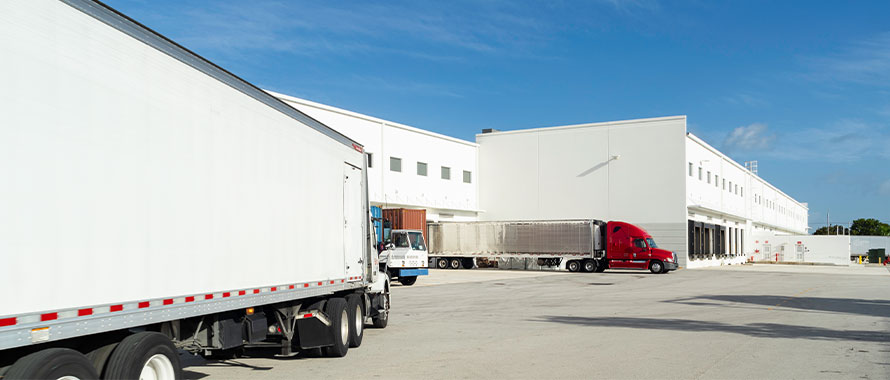
Severe thunderstorms that hit the Dallas-Fort Worth area in late September ripped a 40- to 50-foot hole in the roof of a Walmart distribution center and caused severe damage to several other buildings, according to news reports. An individual at a nearby RV dealership was critically injured in the Sept. 21 storm, which included damaging wind gusts that flipped semitrucks and RVs, FOX Weather reported.
In addition to the roof damage at the Sanger, Texas, Walmart warehouse, trees were uprooted, 2-inch-wide hail was reported, and many other buildings sustained roof and window damage, according to CBS News.
“This was a pretty severe storm,” said Diana Jimenez, Senior Underwriter, Commercial Insurance, Burns & Wilcox, Dallas/Ft. Worth, Texas. “There were a lot of other businesses affected in addition to the Walmart warehouse.”
Rebuilding will take time and significant expense, and the associated downtime could result in further financial losses. These expenses could be covered by Commercial Property Insurance, said Janina Gomez-Rhoades, Underwriter, Commercial Insurance, Burns & Wilcox, San Antonio, Texas.
“Something like this could put them out of commission for a while,” she said. “There are several coverages you would hope a business has on their Commercial Property Insurance to help them rebuild their operations, including coverage for their lost business income and extra operating expenses.”
Weather catastrophes on the rise
Severe weather continues to pose a growing risk to commercial properties, with storms becoming more frequent and intense, leading to costly damage and operational disruptions. According to the U.S. National Oceanic and Atmospheric Administration, 2024 was the fourth-costliest year on record for severe weather with a total of 27 weather and climate disasters that each caused at least $1 billion in damages.
“Mother Nature can be a beast,” Gomez-Rhoades said. Given the damage to Walmart’s distribution center, possible expenses the company incur could include roof repairs, replacing damaged equipment and inventory, and lost business income.
When these catastrophes happen, having adequate Commercial Property Insurance is vital, Jimenez said. “It could take millions of dollars to fix that warehouse and get it back into business,” she said. “That is where business interruption coverage could kick in. Depending on the company’s operations, a temporary location could also be covered.”

It could take millions of dollars to fix that warehouse and get it back into business. That is where business interruption coverage could kick in.
Just two days after the storms in Texas, severe weather in Sallisaw, Oklahoma, on Sept. 23 tore the roof off the Northeastern Health System hospital, requiring patients to evacuate and damaging almost 40% of the building, KFSM-TV reported.
“A hospital is actually, to some degree, one of the best places this could happen because they have a lot of contingency plans in place around getting back up and running again,” said Barry Whitton, Managing Director, Broker, Property Brokerage Division, Burns & Wilcox, Atlanta, Georgia. “As a critical care facility, they may be better prepared for that than a manufacturing facility or apartment building, for example.”
In addition to the cost of repairs, which could include replacing specialized equipment, the cancellation of elective procedures could represent another substantial loss, Whitton noted. “One of the major added costs to hospitals is delaying elective surgeries, which often bring in a lot of revenue,” he said.

One of the major added costs to hospitals is delaying elective surgeries, which often bring in a lot of revenue.
Understanding wind and hail deductibles, other policy terms
Last year, a U.S. Chamber of Commerce survey found that 1 in 4 small businesses report being one disaster away from shutting down, factoring in potential threats such as inclement weather, cyber threats, and supply chain breakdowns. For many businesses, not having insurance could make reopening after a severe weather event impossible, Gomez-Rhoades said.
“Trying to rebuild without the ‘security blanket’ you could have had with insurance can really financially hurt a company,” she said.
Business owners with insurance should ensure that their policy covers loss of business income, as well as forklifts or other machinery, and business equipment that may be attached. “You want to make sure that your building is insured properly, including the right limits for your business contents,” Gomez-Rhoades said. “It is important to protect your business, and ultimately protect your future, by having Commercial Property Insurance and coverage for the loss of business income. If you have a loss, that is going to pay off.”

It is important to protect your business, and ultimately protect your future, by having Commercial Property Insurance and coverage for the loss of business income.
Business interruption coverage is a common misunderstanding about this type of insurance, Jimenez said. “Individuals often think that this is automatically included, but it is not — they have to request it,” she said.
Other key Commercial Property Insurance terms include wind and hail deductibles, which require policyholders to pay a set amount or percentage of damages from wind or hail events — often between 1% and 5% — before coverage kicks in. Whether a policy includes Replacement Cost Value (RCV) or Actual Cash Value (ACV) should also be discussed, Jimenez noted. For a collapsed roof, for example, “ACV is only going to pay what the actual cost is at that moment and not what it costs to replace it, and that could be very different,” she said.
These things “can be a shock” for business owners if they did not understand the distinctions when buying their policy, she said. “If they receive a quote and go strictly by cost, they may not realize the coverages are different. This is where, as agents, it really needs to be explained to the insured,” she added.
Rebuilding amid increasing costs
As the cost of building materials and labor continues to rise, recovering from severe weather damage can be more expensive than business owners may expect. “It is definitely costing more today to fix a building or rebuild after it has been damaged,” Jimenez said. “They may need to look into increasing their limits because of the way the market has changed.”
Another essential coverage for businesses is Commercial General Liability (CGL) Insurance, which can respond to claims of third-party bodily injury or property damage. “If a business was open when a storm occurred and someone was hurt, the CGL Insurance could definitely get brought in,” Jimenez explained. “Legal defense could be covered and then the circumstances of what happened would determine whether the policy would pay anything further.”
According to Gomez-Rhoades, some commercial property owners assume “that they do not need insurance” if it is not mandated by a lender.
“They may say, ‘I have never had a loss in several years. I just do not need it,’ or ‘The cost is not worth it.’ Mother Nature is changing, and we are seeing more destruction of property from severe weather than we ever have in the past,” Gomez-Rhoades said. “The times are changing, the weather conditions are changing. You might think it is not going to happen to you, but you never know.”